
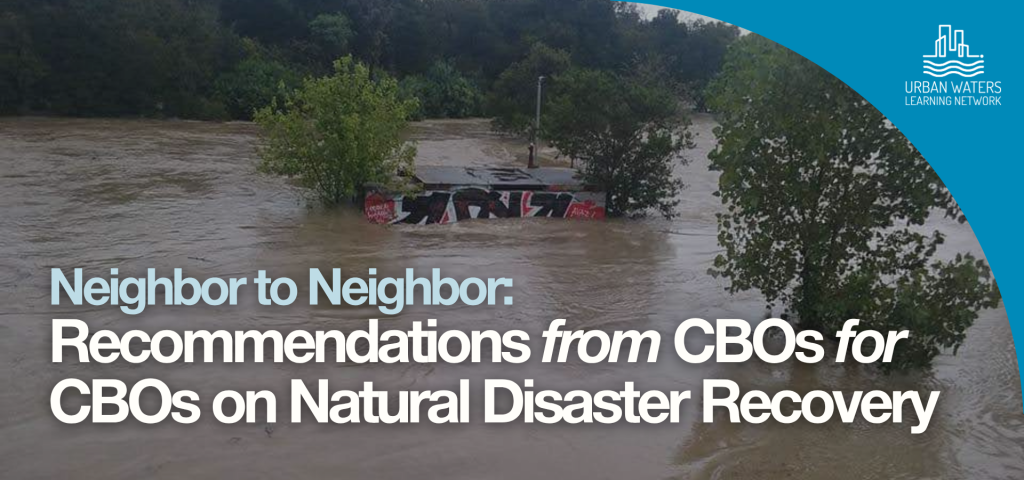
What’s heartbreaking and pretty inspiring at the same time is that most CBOs doing disaster recovery and response aren’t even disaster CBOs
– Ben Hirsch, Co-Director of Research, Organizing, and Development at West Street Recovery
Introduction
When a natural disaster strikes, like floods, droughts, storms, and earthquakes, community-based organizations (CBOs) are often the first to respond. That’s because they’re already there – present before the disaster and long after the news cycle moves on.
This guide shows how water-focused CBOs can support their communities before, during, and after a disaster strikes. You don’t have to be a disaster organization, one whose explicit mission is emergency response or disaster recovery, to do this work. Whether your organization has been doing it for years or is just starting to explore what role it could play, this guide is for you.
It draws directly from conversations with six CBO leaders in the UWLN network, offering firsthand experiences from people who have navigated disasters with strong local roots and limited resources. The examples primarily focus on water-related natural disasters — hurricanes, flooding, and storms — but the lessons extend well beyond, to other natural disasters and extreme weather disruptions. You don’t need to read from start to finish: feel free to jump to whichever sections are most relevant to your organization.
A special thank you to our interviewees:
- Joe Fitzgerald, Milwaukee Water Commons
- Guadalupe Fernandez, Bayou City Waterkeeper
- Carmen Cavezza, Coalition for Environmental Equity & Resilience
- Frances Acuña, Go Austin Vamos Austin
- Rachael Boyce, Communities Responding to Extreme Weather
- Ben Hirsch, West Street Recovery
The Urban Waters Learning Network (UWLN) created this guide because natural disasters are growing more frequent and severe, just as funding for emergency preparedness grows less certain. That makes it more important than ever for organizations working to improve local waterways to be prepared. Thank you to our contributors: Rebecca Tamiru as project lead, with support from Natalia Turkel, Maria Brodine, Diana Toledo, and Jalisa Gilmore. Learn more about UWLN here.
What is the Disaster Management Cycle?
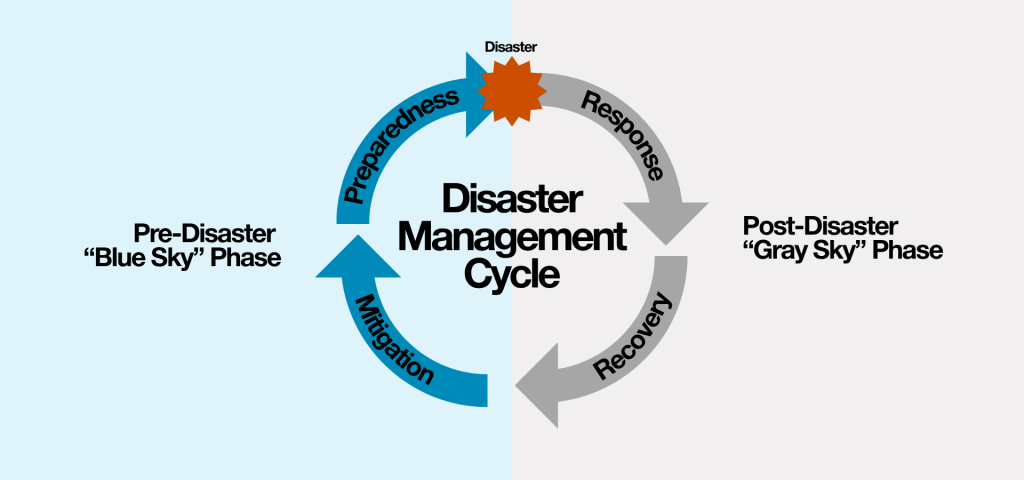

The disaster management cycle is a framework that breaks disasters into phases, mapping out how to prepare for a disaster and respond when it strikes. It’s often represented as a cycle because communities are frequently still recovering from one disaster while preparing for the next one. This guide categorizes the cycle into two phases: Pre-Disaster “Blue Sky” Phase and Post-Disaster “Gray Sky” Phase.
Pre-Disaster Phase: “Blue Sky”
- Mitigation: proactive, preventative efforts to reduce disaster risk (e.g., flood resilience planning, watershed restoration projects, or preservation of wetlands)
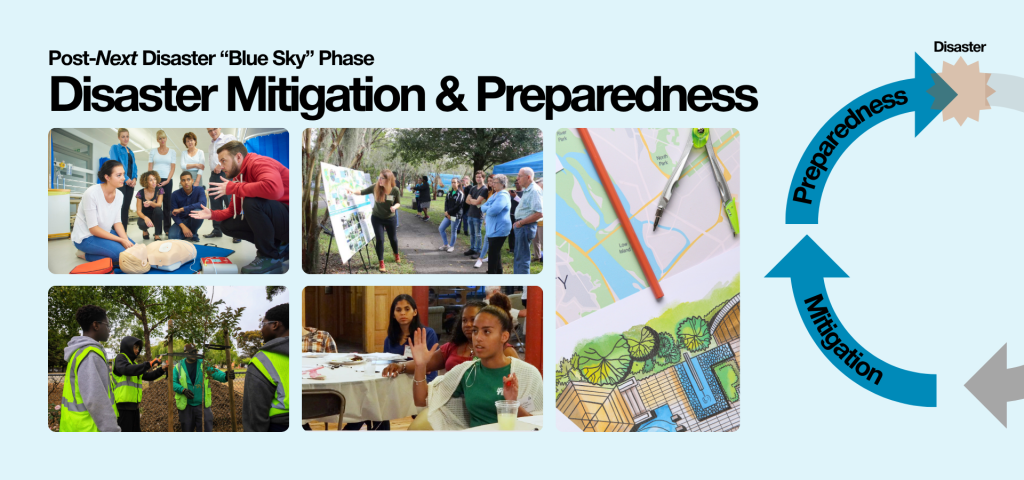
- Preparedness: planning and capacity-building to prepare for a disaster (e.g., connecting volunteers with first aid trainings)
Post-Disaster Phase: “Gray Sky”
- Response: actions during a disaster and the 2-4 weeks afterwards (e.g., providing food, water, and shelter)
- Recovery: long-term rebuilding (e.g., home repair)
Before the “Storm”: Blue Sky Mitigation and Preparedness

The best time to prepare for a disaster is far before it strikes. Planning ahead and building long-term stability determines how well residents, businesses, and infrastructure recover from disaster when it hits. But preparing isn’t just about stockpiling supplies or drafting emergency plans – it’s also about cultivating the relationships, skills, and systems that allow your organization to act quickly and effectively when disruption occurs. Here are five takeaways from our interviewees on how to make the most of the calm before the storm.
Takeaway #1: Every CBO has a role to play in disaster work
There is a role for every CBO in disaster work. Each organization’s work should be rooted in its mission and its community’s needs, which means that the work can take many forms. This work can look like reducing flood risk by protecting wetlands, improving water quality through green infrastructure solutions, and increasing transparency in public fund allocation.
Identify what you do and don’t do.
“We are not a response organization. Maybe we should be, and maybe one day the community asks that of us. But right now, that’s not our space. We make an impact in other ways”.
– Guadalupe Fernandez, Policy & Partnerships Manager at Bayou City Waterkeeper
Lead with what your organization already does well. Identify what you do and don’t do to prevent overstretching and mission drift. It helps to be clear on what your organization’s strengths and skillsets already are. For example, an organization dedicated to increasing resident access to clean water has the foundation to focus on clean water access during a disaster.
Stay flexible as needs change.
“We went into disaster mode and asked ourselves, ‘How can we help our residents right now?’”
– Carmen Cavezza, Senior Manager of Climate Justice Programs at CEER
While it’s important to maintain the core of your work, expect your organization’s role to shift once disaster hits. After three hurricanes in 2024, Coalition for Environmental Equity & Resilience (CEER) based in the greater Houston region, shifted from offering weatherization application support to helping residents submit FEMA applications.
Takeaway #2: Proactively Build Your Partner Network
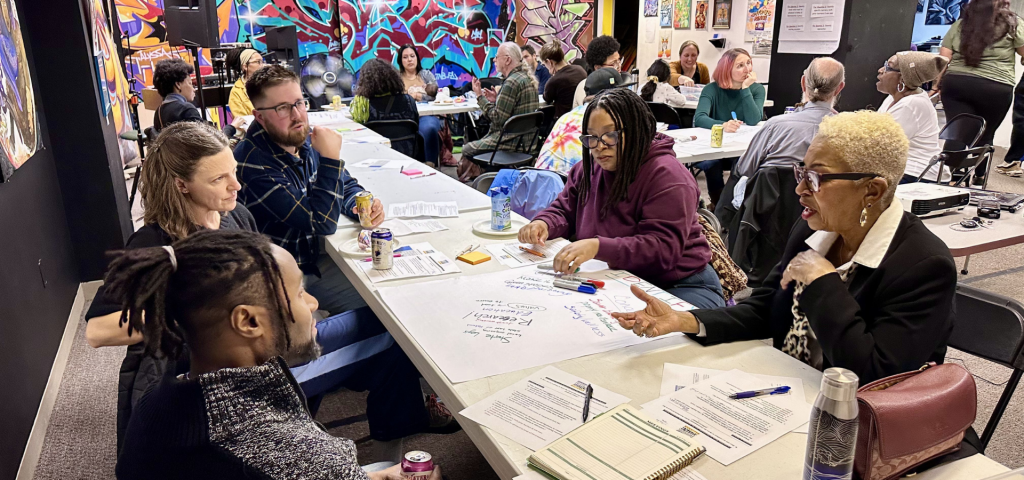
Milwaukee Water Commons
No single organization can meet all a community’s needs when disaster strikes – not even organizations built for disaster response like the Red Cross. An effective response requires a network of CBOs, government, and other groups all working together. That’s why it’s essential to build relationships before a disaster – knowing what organizations and resources exist in your community and building authentic relationships with them means your organization can act quickly when it hits.
Map community partners and resources.
Think broadly: community emergency response teams (CERTs), social service agencies, emergency management offices, utility providers, mutual aid networks, community centers, churches, schools, and other CBOs.
This rolodex helps organizations point people to resources quickly. For example, during Winter Storm Yuri, Cavezza of CEER relied on a WhatsApp group coordinated by Houston in Action, where local organizations and leaders crowdsourced resources and shared requests for help in real time.
Dive Deeper with this Resource: Participatory Asset Community Mapping or Asset Mapping
Build relationships with key contacts in your map.
Proactive relationship building will position you to act faster when in a crisis. For examples, Bayou City Waterkeeper had a direct line to staff at the local Public Works department. During boil water advisories, they’d text the water director to find out what was happening and then pass that information to their network. That trusted relationship was built during ordinary, non-disaster work and proved useful during disasters.
Dive Deeper with this Resource: River Network’s Building Blocks of Trust: Creating Authentic and Equitable Relationships Between Community Organizations and Water Utilities
Join formal disaster coordination networks.
Local or regional COADs (Community Organizations Active in Disaster) like this one active in Southeast Wisconsin or VOADs (Voluntary Organizations Active in Disasters) are networks of nonprofits, government agencies, contractors, and institutions that coordinate response during disasters. Joining one creates a clearer understanding of roles and responsibilities before a disaster.
Example: Go Austin Vamos Austin (GAVA) is part of the Austin Resilience Network, where CBOs and city agencies work together to respond during disasters. The city shares instructions and updates, like when resilience hubs open, and GAVA disseminates that to community leaders who will inform their neighborhoods. It works both ways: GAVA brings community needs and updates back to the Network.
Takeaway #3: Build Strong Relationships with Government
Building strong relationships with local governments is vital. Government partners often have the infrastructure for coordinating emergency communications or delivering resources that CBOs can utilize.
Lead with a collaborative approach.
Approaching government relationships with a spirit of reciprocity and collaboration, alongside accountability, yields more productive partnerships.
Example: Bayou City Waterkeeper, working across greater Houston, actively advocates at the state and federal levels for resources and funding that would benefit the city, which has built a track record of goodwill. This foundation creates room for them to challenge the city directly when necessary. “When we have to be critics, it’s in a loving way,” shared Fernandez.
Example: Frances Acuña at Go Austin/Vamos Austin (GAVA) shifted her approach from accusatory to collaborative after realizing it yielded better results. Instead of saying “you haven’t done this work,” she reframed it as a shared challenge: “We went through this and we didn’t have these things. We want to make sure that next time it happens, we can work together so we’ll be better prepared. This is what we can offer, but we need your support.’”
Know where to focus your energy.
Don’t lose time trying to win over those who won’t budge. As Cavezza of CEER shared, “Know who, no matter what you do, they’ll turn you down”. Instead, focus your relationship-building on a narrower range of potential and active supporters.
Dive Deeper with this Resource: The Spectrum of Support tool helps organizations engage strategically by creating a spectrum of where public officials and entities stand.
Takeaway #4: Invest In Your People
While physical infrastructure matters (e.g., supplies, shelter, etc), the most valuable investments in disaster preparedness are investments in the people. This includes building skills, providing training, and creating clear pathways for volunteers to contribute and for leaders to grow.
Offer skills-building opportunities.
Skills training builds community capacity for disaster resilience. For example, during three consecutive years, West Street Recovery recruited 50 community members to receive urban wilderness first aid training. The goal was that when the next disaster hit, residents would have the skills to help each other. Leadership development matters too – like CEER’s flagship climate ambassador program, which trains community members to educate and advocate for local water equity and climate resilience.
Develop a volunteer engagement pathway.
“Can you still be getting volunteers to come four months after the disaster? Because people are still going to need help.”
– Ben Hirsch, West Street Recovery
Disasters bring waves of volunteers, but the challenge lies in sustaining that momentum months later when community needs are just as acute. Setting up volunteer recruitment systems and defining specific roles before they are needed allows organizations to quickly plug volunteers into clear, meaningful work from day zero, which helps sustain longer-term support.
Develop internal policies to support your people.
Discuss early on how work will change in “blue sky” and “gray sky” times, and consider how to support one another. For example, BCW suggests building in flexibility for staff to take time off to help neighbors or their own households and developing roles that can be filled by those who are less directly impacted, like putting staff who still have electric power on call to reshare information resources that come their way.
Takeaway #5: Meet People Where They Are Through Trusted and Accessible Communications
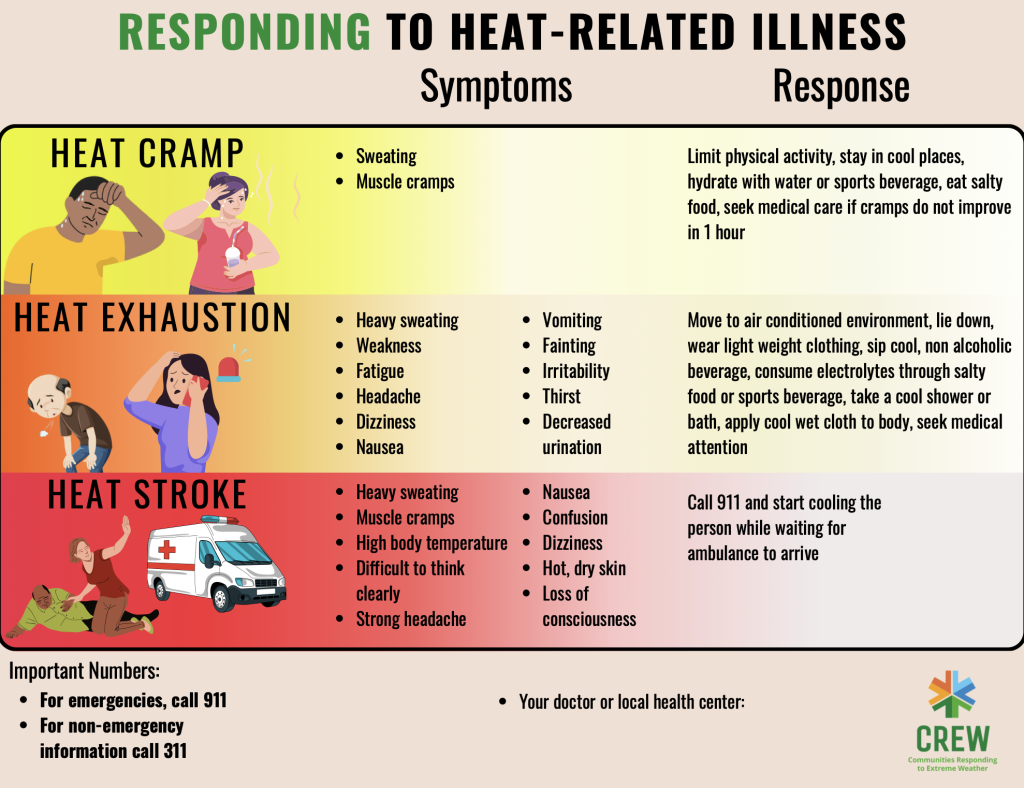
Extreme Heat Education Booklet, Communities Responding to Extreme Weather (CREW)
During and in the immediate aftermath of a disaster, there is often a whirlwind of information, misinformation, and disinformation in the community, leading to confusion and people missing out on critical resources. Here are proactive strategies for cutting through the noise.
Use trusted messengers.
In communities that have been underserved and harmed, trust in unfamiliar organizations is thin – especially in moments of crisis. When hesitant community members need reassurance that a resource is safe, the messenger often matters more than the message. Hyperlocal partners like churches or community centers can serve as trusted vehicles for amplifying information and resources.
Example: Ben Hirsch from West Street Recovery shared how leveraging trusted messengers was essential for encouraging community members to use the FEMA digital application. “Doris would tell her people [it was] safe. They have a connection and trust because they go to church together or their family knows each other… which is way better than me telling them.”
Example: Carmen Cavezza from CEER described a situation where community members would become unreachable to contractors trying to follow up after signing up for weatherization and utility assistance programs. “If they don’t know you, they’re not going to answer the phone, no matter what you have to offer. And if they end up answering the phone, they are going to distrust the message”. Building in warm hand offs when connecting community members to outside organizations can help overcome trust barriers.
Dive Deeper with this Resource: The Community-Centered Solutions Toolkit helps organizations understand how to build community trust.
Use multiple communication channels.
No single communication channel can reach everyone. Layer multiple modes of contact to reach as many people as possible, from social media to radio to doorknocking. Communication channels that rely on the internet often fail during disasters due to power outages and damage to telecommunications infrastructure.
Example: Bayou City Waterkeeper shared that during a winter storm, their city went without power for a week and yet boil water advisory notices were still being issued online, leaving many people unaware of the alerts. Plan for these disruptions – it can be as low-tech as developing relationships with contacts in local radio stations willing to share your messages or as high-tech as setting up community internet.
Keep your language simple and clear.
Translating government resources into plain language for the community is an important need during disaster relief and recovery. As Frances Acuña from GAVA put it, “Sometimes people assume that the community has the information because it’s all over the city’s social media and website. But the reality is, it can be difficult to navigate and understand”.
After The “Storm”: Gray Sky Response & Recovery

The weeks and months after a disaster are when gaps in formal response systems become the most visible. Government agencies and large disaster relief organizations play an important role, but they often fall short in reaching communities that need help most.
Burdensome vetting processes, bureaucracy, language barriers, and strict eligibility requirements can delay aid for days or weeks and means many people slip through the cracks. Our interviewees offer four key takeaways for how CBOs can fill these gaps during response and recovery.
Takeaway #1: Invest in Community Networks
“People on the ground in their neighborhoods know what’s best and what the people need”
– Guadalupe Fernandez, Bayou City Waterkeeper
Informal networks of support, organized by neighbors for neighbors, are one of the most effective strategies in disaster response. These networks self-organize to identify needs, connect community members to resources, and advocate for additional support like calling council members directly to ask why shelters aren’t set up in their zip code.
Amplify and resource what’s already happening.
Joe Fitzgerald of Milwaukee Water Commons shared how during the August 2025 floods, residents went out in canoes to rescue neighbors from flooded homes, clear storm drains, and help drivers stuck in flooded streets. “Neighbors jumped in and supported one another”. CBOs can lend their structures, capacity, and credibility to multiply the impact of what neighbors are already doing. This can look like connecting community networks to supplies or funding.
Support informal network recognition.
CBOs can also help document and map these emergent networks after they arise.
Example: Asheville, NC’s Resilience Hub mapping project shows how capturing what’s already working on the ground can offer these community networks more recognition and investment over time.
Takeaway #2: Distribute Resources Rapidly and Accessibly
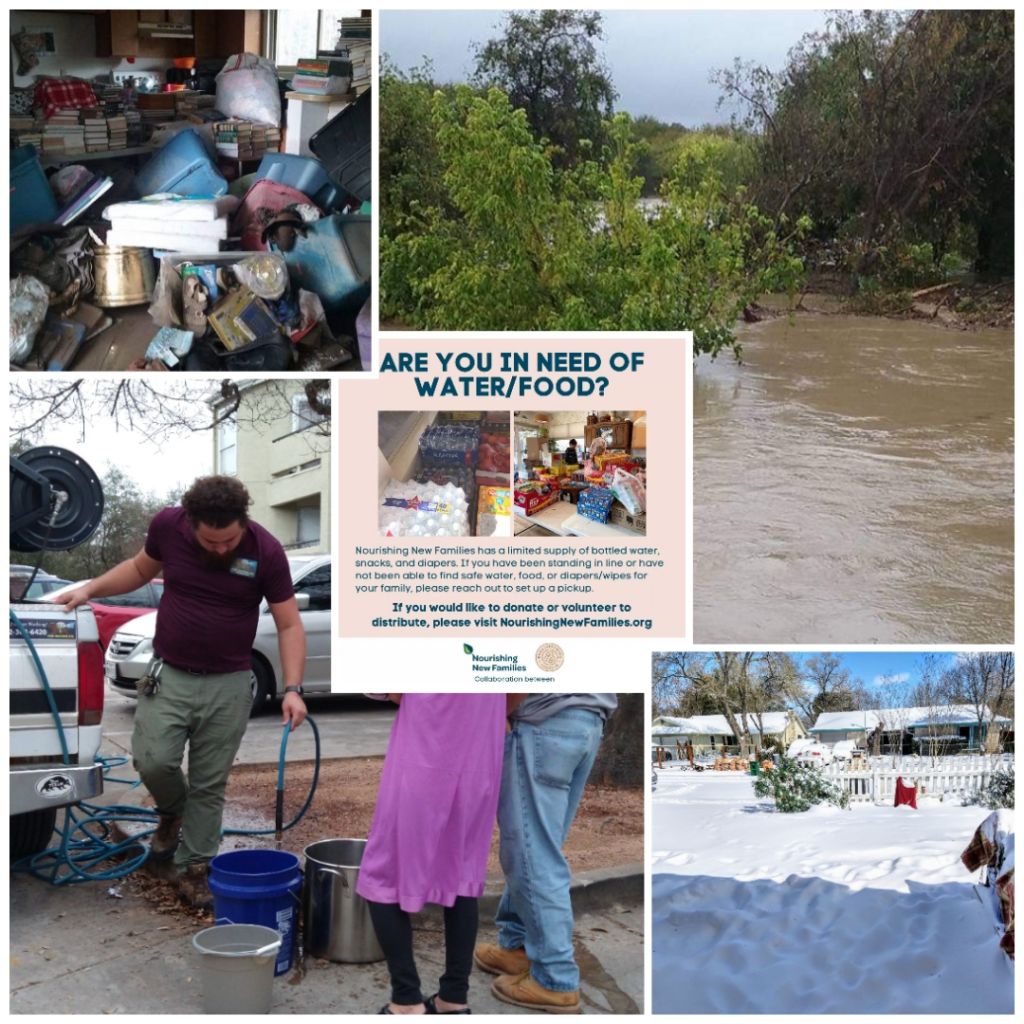
Go Austin/Vamos Austin
When disaster strikes, the immediate response shapes everything that follows. When West Street Recovery conducted a community research project on long-term recovery, community members they interviewed would often shift towards emphasizing the immediate events of the first days and week after the disaster. This is because “everything that happened after was set in motion in that first week”, shared Ben Hirsch of WSR.
Effective and rapid disaster response means not only making sure people know what resources are available, but actively supporting their access to those resources by addressing issues of community mistrust, minimizing barriers, supporting follow up, and improving accessibility.
Lead with trust when distributing resources.
Assume that if someone shows up, they need help. West Street Recovery put this approach into practice through their hub houses, where community members receive small amounts of cash assistance without intensive vetting or having to prove they need help.
Example: ”If you show up at my Hub house, I assume that you need $100. I don’t know if you earn $2K or $60K a year. But if you walk here, you probably need $100” shared Ben of WSR. That approach helped WSR build trust and community members were more willing to engage with them.
Set up internal systems for speed and flexibility.
Minimize bottlenecks that can slow down aid delivery. This can look like empowering rapid response volunteers to distribute resources – like food, water, and small amounts of cash – without having to check in for approval on each request.
Plan for accessibility barriers.
Trying to access government resources like FEMA assistance or home repair programs can be a challenging and frustrating experience, especially for people encountering them for the first time. Simply sharing applications for programs is likely not enough. Consider how to support community members in accessing these resources, like building in time to help less tech-savvy people create accounts or fill out online forms.
Example: During Hurricane Beryl, WSR proactively reached out to impacted community members and encouraged them to apply for FEMA assistance. When people reported that their applications had been denied, WSR tracked those instances, flagged denials to legal partners so they could assist with appeals, and built a spreadsheet tracking 180 applicants, following up with them every two weeks.
Takeaway #3: Develop Resilience Hubs
“Knowing they have a place to go helps the community feel safe”,
– Cavezza, CEER
Resilience hubs – facilities like neighborhood centers, libraries, or houses of worship that local residents can turn to for resources and support – play a key role in disaster response. They provide tangible support like shelter, phone charging, food and water, medical supplies, and hygiene services. But they also offer something less tangible and equally important: a sense of safety and stability in a moment of crisis. For CBOs, developing or strengthening resilience hubs doesn’t mean starting from scratch, but building upon assets they already have.
Think broadly about what a hub can be.
Resilience hubs don’t have to look the same for every organization or community. CBOs have found creative ways to develop hub capacity that reflects their available resources and community context.
Example: Communities Responding to Extreme Weather (CREW) uses a tiered model that acknowledges that hubs can grow over time, from offering outreach and education, to providing direct support like first aid, to eventually offering emergency overnight shelter.
Example: West Street Recovery (WSR) developed “hub houses” that equip neighborhood leaders to turn their own homes into emergency resource centers, distributing solar panels and batteries, rescue equipment and basic medical supplies during disasters or power outages.
Dive Deeper with this Resource: Urban Sustainability Directors Network (USDN) developed a Hub Model Guide that helps communities think through how to develop resilience hub capacity, from initial planning to providing emergency services during a disaster. Access it here.
Build community buy-in.
A hub needs to be well-trusted and well-utilized, so building resident connections with the location through day-to-day programming when there’s no active disaster is key.
As Rachael Boyce, Climate Justice & Resilience Manager of Communities Responding to Extreme Weather (CREW) put it, “If you put a bunch of chairs in a gym with AC, no one’s going to go because they’ve never spent any time there. You’d be more likely to stay at home”. Community gardens, seed libraries, English as Second Language (ESL) classes, and DIY weatherization workshops are all ways to build that connection.
Design for accessibility from the start.
A hub that isn’t accessible to the community’s most vulnerable members isn’t fully doing its job. Identify vulnerable populations in the “blue sky” planning process and build in accessibility – like language, financial, mobility, and transportation – to address barriers from the beginning.
Takeaway #4: Engage in Long-Term Recovery
Emergency conditions persist well beyond the “end” of the disaster event and long after attention and resources have waned. For many communities, the road to recovery stretches months if not years. Because CBOs are embedded in communities long before and long after disasters, they are well-positioned to sustain this marathon work.
Consider Joining Long-Term Recovery Groups.
Long-term recovery groups (LTRGs), organized among CBOs, direct service providers, and government agencies, fill critical gaps and create long-term structure for needs that extend beyond the emergency response phase. They improve coordination and communication among participating organizations and help people who fell through the cracks get the support they need, including those who were deemed ineligible for state or federal assistance.
Hold Space for Post-Disaster Community Reflection.
Intentionally cultivating reflection spaces with partners to assess what happened during a disaster can lead to better outcomes long-term, shifting organizations from reacting to being proactive.
Example: After the August 2025 floods, Milwaukee Water Commons (MWC) participated in the Milwaukee Environmental Justice Alliance. “We asked questions like ‘What did we see? What infrastructure needs to exist to stay connected?” shared Fitzgerald of MWC. These conversations gave organizations across the network the opportunity to discuss what they were doing, what they weren’t doing, who was filling gaps, what they were seeing in their community, and identify possibilities for deeper collaboration.
Conclusion
If there’s one thing to take away from this guide it’s that many CBOs doing disaster work aren’t disaster organizations at all – they’re Waterkeepers, community organizers, or neighborhood advocates who stepped up during a crisis because their community needed them to.
CBOs don’t need a new mission, budget, or rebrand to do disaster work, they only need what they already have: trusted local relationships, insight on the community’s needs, and the ability to take action. Regardless of the strategy, it’s important to think about your organizations role during in the “blue sky” times. If you want to dive deeper, check out our toolkit compiling disaster resources from organizations across the network doing this work or visit our storymap.
Thank you again to the leaders who took the time to share their insights with the broader community!
- Joe Fitzgerald, Milwaukee Water Commons, Wisconsin
- Guadalupe Fernandez, Bayou City Waterkeeper, Texas
- Carmen Cavezza, Coalition for Environmental Equity & Resilience, Texas
- Frances Acuña, Go Austin Vamos Austin, Texas
- Rachael Boyce, Communities Responding to Extreme Weather, National
- Ben Hirsch, West Street Recovery, Texas